

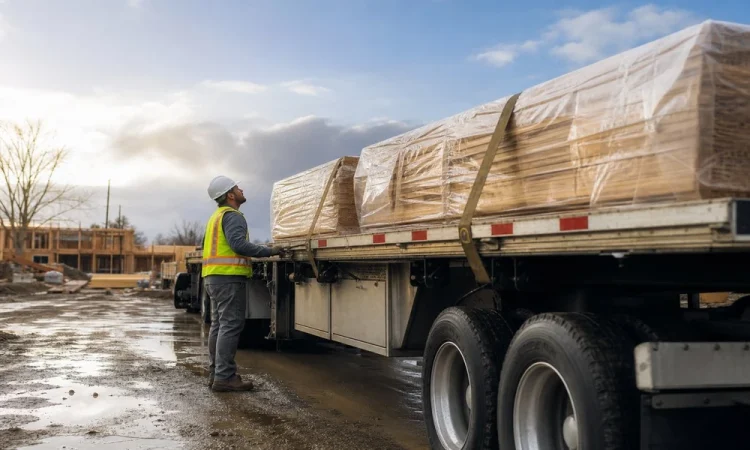

Following a weather delay, a construction site can transform from deserted to swarming in the course of one morning. There could still be puddles near the fencing in San Jose as the superintendent compares permit windows, rental contracts, and a delivery ticket with a coffee stain on it. Materials must be delivered in the sequence that allows the crew to keep working, because every lost hour costs a scissor lift, a framing crew, or a lane-closure permit.
Match Each Delivery to the Crew’s Schedule
A jobsite doesn’t require all its finishes on day one. Framing materials like steel studs, track, insulation, and drywall are generally needed before tile, fixtures, and boxed hardware. Sending four pallets of tile to a downtown renovation before interior walls are erected means the tiles will be stored on pallets beneath a tarp by the curb where they can be damaged by rain and forklift traffic.
The order of delivery is crucial.
Check that deliveries are scheduled in the correct order for the work to be done. If framers are on-site on Monday, a load of lumber may need to be staged before 8 a.m. when the lane-closure begins. Drywall should be delivered once the crew has a dry area to store it. Finish materials shouldn’t be delivered until they won’t need to be moved several times to make room for ladders and carts.
Confirm Access and Unloading Equipment
Renovation projects in downtown San Jose often don’t have a loading dock, a permanent forklift, and may only have a gate that scrapes along the fencing. A delivery truck might be able to reach the block, but may not have anywhere to safely park the freight.
Confirm these items with the jobsite before dispatching the truck:
-
Does the site have a forklift, telehandler, pallet jack, or does it require a liftgate?
-
Is the gate wide enough? Are there any low-hanging wires or signs? Is there sufficient clearance?
-
Can the truck wait somewhere that doesn’t block the bike lane or an apartment driveway?
-
Who will be available to receive and sign for the freight?
Gold Rush Express Delivery
910 Bern Ct #150, San Jose, CA 95112
(408) 292-7300
https://www.goldrushexpress.com
For a small commercial remodel, a liftgate may be appropriate if a few boxes of hardware or a couple of pallets of wrapped supplies need to be unloaded to street level. It isn’t useful for long steel studs or lumber that requires a forklift. A forklift with the right size forks and turning radius (Wikipedia spells this out at www.en.wikipedia.org/wiki) may be required, even if the site manager tells you it’s “no problem.”
Protect Materials From Rain and Storage Delays

Palletized construction materials
It doesn’t take much rain to cause problems. Water can get through a hole in the plastic wrap, soak the bottom of a drywall panel, or pool in the creases of a cardboard tile box. Palletized lumber should be kept off the ground and under a cover that is properly secured to prevent flapping in the wind and blowing into a driveway.
When scheduling Freight Service, let the receiver know the expected delivery window and confirm where weather-sensitive materials will be stored once unloaded. A crew might have an empty space available, but access to the space may be blocked by a locked door or a ramp too steep for a pallet jack. These things are easier to resolve the day before delivery than when the truck is already at the curb.
Prior to the departure of your shipment, please create a straightforward laydown map designating crane swing zones, fire access paths, pedestrian corridors, and specific locations where pallets should be placed.
If you have a mixed load, please request that the supplier load the pallets in the reverse order they will need to be unloaded, eliminating the need for time-consuming re-organization upon arrival.
Coordinate Restricted Hours and Document Damage
Downtown streets can be restricted due to morning commute traffic, roadwork, school drop-off hours, and lane closures. A truck arriving just 15 minutes late might find the lane already barricaded and unable to proceed.
A delivery of four pallets of tile should allow sufficient time for the driver to check in, unload, and leave, and this isn’t just about the arrival time listed on the bill of lading. Ensure the permit number, site contact, and any delivery-specific instructions are included in one communication. A half-stuck zone sticker on the door isn’t helpful to a driver looking for a spot.
Record Issues Before the Truck Leaves
Check the freight while the driver is still at the site. Look for crushed corners, broken bands, ripped plastic, wet boxes, and loose pieces near the back of the trailer. Photograph the pallet labels and damage and make a notation on the delivery receipt.
If the freight needs to be replaced, photos and delivery notes will help the supplier and carrier start the process while the rest of the job continues. Keep the damaged materials separate, tag the affected pallet, and send the delivery record to the purchasing agent before the afternoon schedule changes.